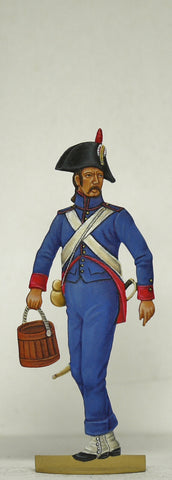
With a change of job just around the corner, I seem to have a little more time on my hands in the evenings, which is good as the Spanish won't paint themselves, with a self imposed deadline of Thursday evening I wanted to ensure these were off the paint table.
Within the campaign setting they will be regulars in sections of 8. I have a couple of Big men to bolster the ranks with a couple of mounted figures to come later. As usual the Infantry are from Trent Miniatures, with Officers and drum from Front Ranks Spanish Range, they are a good match once painted and based.
The Spaniards whilst a major player in the region seem to be somewhat overlooked in terms of history and documented accounts, I suspect because they seem to be on the losing side in a number of the encounters. There may be some Spanish text but I have not been able to track down much.
Here's my take on events pulled from a couple of different sources for those interested.
Once the French Revolution reached Haiti shores it's impact was bound to spread across into the Spanish part of the island. As early as 1789 the governor of Santo Domingo, Don Joaquín García y Moreno, put his troops on alert when news of the revolution broke. Despite the events across the border there was no significant incursion into Spanish territory. The Spanish undertook a policy of watching and waiting hoping that the mutual destruction of the warring factions would allow them to regain their lost influence and power in the region.
When Spain and England declared war on France in 1793 the Spanish colonists stopped cooperating with the French. They supplied arms to the likes of Biassou and Louverture as well as offering asylum to rebel leaders, before to long Spanish troops were fighting the French alongside the rebel slaves.
The Spanish abolished slavery to win over the black majority. However Louverture abandoned the Spanish and went over to the French as he believed they were more genuine in their desire to free the black majority. With the loss of the black rebels the Spanish started to lose territory to the French and Haitian loyalists. The Spaniards abandoned the frontier posts of San Rafael, San Miguel, and Hincha, and to regroup in the towns of Las Caobas and Bánica in the center of the island, and in Dajabón, Bayajá, and Montecristi, in the North.
Las Caobas und Bánica fell to Louverture when news of the end of the war in europe reached the island in 1795 just as the Spanish were starting to fight back.
Peace was to be short lived once again Louverture crossed the border in 1801 and captured the city of Santo Domingo followed quickly by the rest of the island. Despite the promise of ending slavery to incite the local blacks to support him, he was to break this promise.
Louverture only left Spanish territory when a newly arrived French expedition landed to retake the island.
So there you have it a potted history of the Spanish in Haiti - Let's see if they can do better in our campaign.