Showing posts with label Smugglers. Show all posts

Sunday, March 19, 2017

Pistols at Dawn - A Cutlass! Scenario

After a few weeks of slowly plugging away at the Smugglers and Marines time to give them some table time and a refresh of the rules before considering how a rolling campaign campaign might look.

A very small scenario with a party of smugglers who have rowed up river and are looking to retrive their landed goods from a barn at the far side of town. The Government forces need to stop them.


I priced up each of the figures and armed them with what they were cast with, that provided me with $493 worth of privateers and $466 worth of Marines pretty even or so I thought.


The Smugglers split in to two groups looking to make there way through the town. Armed with Cutlass and Axes I should have guessed that they might be quite tasty in Hand to Hand.


The Marines step out into the street looking to block their path - A cornish stand off.


After the occasional pistol and musket shot one of the Marines looks to take advantage of a spooked smuggler and moves on the first group of tax dodgers. A poor idea on my part as a poor authority roll on the next turn allows the smugglers to surround the brave yet foolish trooper.


Meanwhile in the main street the Captain of the guard is confronted by to members of the gang has they attempt to rush forward to support the lone trooper. 


With the bulk of the patrol now drawn into an uneven brawl a number of the Marines are cut down, their muskets no defence against slashing Cutlasses and one Mariner who armed with nothing but a long spear dispatches two of the government men - Those exploding dice can be deadly.

The customs men are forced to withdraw.

The morale of this encounter - don't be cocky just because you have a flash uniform and play to your strengths, Marines are far better at standing back and shooting at their enemy rather than wading in with the bayonet it will only end badly.

After a few turns the rules turned at to be far more tactical in their nature than the original read through suggested, do you hold back on activations or use them all at once?
Attacking players from the side gives you an advantage but you in turn need to protect your flanks.
Once you are in combat your activations are soon used up reducing the ability to bring reinforcements in.  

Plenty to think about in the next outing - Now to read the campaign element.

Sunday, March 12, 2017

Black Scorpion - Pirates & Smugglers of the Devon coast.

Another batch of Pirates and Smugglers complete from the chaps at Black Scorpion for use within their Cutlass! rules.
Cast in resin I was a little concerned at first, but they take paint well and contained very little flash, it will be interesting to see how they stand up to wear and tear on the table top as they are a touch on the light side.


I figured these fine fellows would be ideal for smuggling games in the coming months.

With the annual Devon holiday booked this year, there is an added interest this time around rather than the usual holiday hangout of Tea Shops and Seaside amusements. A chance to slip away to walk the Smuggler beaches from the 1700's that should make the kids happy. :-)

Reading up on the period there is a vivid picture of the Smuggling activity in area in the letters of  Philip Taylor, who was Collector of Customs at Weymouth from 1716.

During the winter of 1717-18 he wrote: "the running of great quantities of goods having of late very much increased" - the government tried to push through a bill for the prevention of smuggling. It fell down in the House of Lords and, as a result, reported Philip Taylor the following April, "the smuggling trade is prodigiously increased and they and all persons concerned with them are become more insolent than ever and dares any power to oppose them, which will very soon have a very bad influence on trade. Besides, as these smugglers are generally the dissatisfied part of the country, their riding in troops of thirty or forty armed men on the least appearance of an opportunity will be dangerous to the peace of the country as well as troublesome to the Government." The smugglers even had the audacity to claim - and they used the failure of the smuggling bill as their evidence, that they were now "tolerated in smuggling by the King, Lords and Commons."

The bill, - which, among other things, forbade the importation of cargoes in vessels of under fifty tons - finally became law twelve months later, but by then Taylor was writing in colourful style:
"The smuggling traders in these parts are grown to such a head that they bid defiance to all law and government. They come very often in gangs of sixty to one hundred men to the shore in disguise armed with swords, pistols, blunderbusses, carbines and quarterstaffs; and not only carry off the goods they land in defiance of officers, but beat, knock down and abuse whoever they meet in their way; so that travelling by night near the coast, and the peace of the country, are become very precarious; and if an effectual law be not speedily passed, nothing but a military force can support the officers in the discharge of duties."


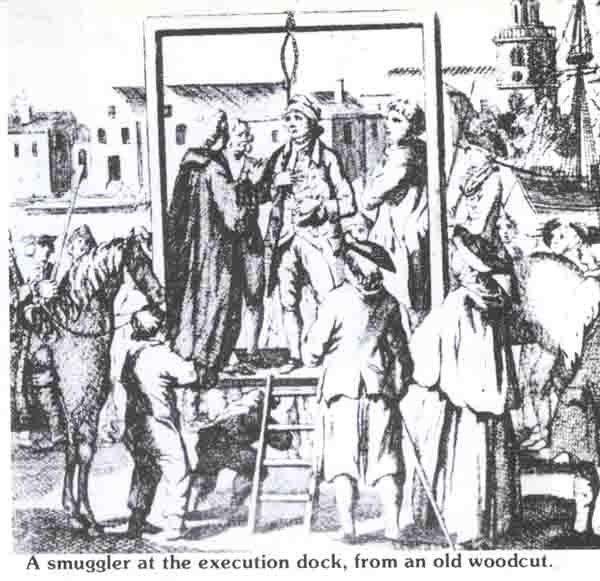
Philip Taylor was not exaggerating when he reported that "the tumultuous and riotous proceedings of the smugglers is not anything abated but daily growing upon us". He went on: "Most of the smuggling trade in this country is now carried on by people in such great numbers, armed and disguised, that the officers, if they meet them, can't possibly oppose them therein, nor do otherwise than search for the goods in suspected places, which by means of the country's favouring the smugglers, very often proves ineffectual and expensive to the officers." But if they did get caught and sentenced, they could be hung!


A smuggler at the execution dock from an old woodcut

Brandy and wine made up the bulk of the contraband cargoes landed in Dorset between 1716 and the mid-1730s, but many other commodities appear in the lists from time to time, including rum, coffee, tea, salt, pepper, cocoa beans, vinegar, cloth, silk handkerchiefs, tobacco, playing cards, foreign
paper and logwood sounds like an order to the guy's at Anisty is in order.

At Abbotsbury a young Customs officer, Joseph Hardy, was repeatedly ordered by Philip Taylor to retrieve the goods, but when he did so, he was obstructed by a gang of locals and immediately lost them again. Taylor commented sarcastically: "They [Hardy and Whitteridge] being both the most original fools I ever met with or heard of, in the scuffle of taking the goods away I can't find any blow was struck on either side and (it appears) that the heroical officers were directly frighted out of their goods."
Taylor recognised, though, that just about every person in Abbotsbury was an employee of the smugglers and concluded that the only way to settle the matter was to call in the army, who had been ordered to help the fight against smuggling when requested.

Accordingly he sent a message to Lieutenant Carr, commanding officer of Lord Irwin's Regiment of Horse quartered at Dorchester, and on November 16, Quartermaster William Thomson left the county town with Joseph Hardy and eighteen troops. On arriving at Abbotsbury, they found "a great mob of people gathering themselves about them" and Hardy summoned the parish constable and tithingman and asked them to help keep the peace. At the sight of the troops, Bradford the bailiff changed his attitude rather suddenly, handed over the keys and allowed Hardy to recapture the goods in the face of a vociferous but otherwise peaceful crowd.

Now there must be a scenario or two in that account.


Saturday, August 27, 2016

Smugglers and Wreckers.

The blog and hobby generally has really fallen behind in recent weeks, what with a couple of holidays and trying to play catch up at work to make up for the "rest". 

Devon was rather wet.
What did I expect for August in the UK?

However looking for things to pass the time I wandered into a couple book shops who had a number of small booklets on the Smugglers and Wreckers of North Devon. Perfect as I had been looking at the Black Scorpion range for several weeks thinking about how I could find a use for them.

 Privateers 2


During the 17th and 18th centuries smuggling or Free Trading was commonplace in the West Country and considered to be a very profitable way of life!

Smugglers were known to have used Lee, Ilfracombe, Heddon’s Mouth, Watermouth Cove and Morte. Some of the smuggling operations were clearly considerable; in 1785 a 96 gallon cask of rum  was found at Watermouth Cove and in 1801 224 gallons of gin and 164 gallons of brandy were found on the foreshore near Ilfracombe. 

Pirate girls 2

Wrecking was another popular activity, as goods were washed ashore from a wrecked ship were regarded as common property. The wreckers of Mortehoe were notorious and feared by sailors it was said a sailor would rather drown than come ashore at near the men of Morte.
Any ship in trouble brought locals to the shore and in no time the ship would be destroyed and its cargo carried away. It was illegal to claim salvage from a wrecked ship if anyone was found alive on it. Therefore the wreckers would dispose of any survivors!
One of Mortehoe's most notorious wreckers was Elizabeth Berry, who it is thought used her pitchfork to drown sailors." (she was arrested for plundering the William and Jane in 1850 and given 21 days hard labour).

Governor

It seems that everyone was involved; in 1783 all the Ilfracombe pilot boats were suspected of smuggling and one, the Cornwall, was seized and cut up into three parts. An Ilfracombe Collector from 1804-1824, Thomas Rudd, was father in law to a known smuggler, Cooke, who was never caught. In 1825 the richest man in Combe Martin, John Dovell, was prosecuted for handling smuggled goods.

The most infamous smuggler in north Devon was Thomas Benson, who in 1747 became MP for Barnstaple. The following year he was granted a lease on Lundy Island and entered into contract with the Government to carry convicts abroad. 
However, he landed them on Lundy instead to run his smuggling operation. He became over confident and was fined for smuggling and stripped of his office. He didn’t pay and his lands in Bideford were seized. To recover his losses he persuaded the Captain of the Nightingale to fire it for the insurance, but the plan was discovered and he fled to Portugal. 

Now they sound like some cracking scenario's to me....
Just the tonic to kick start the hobby again....